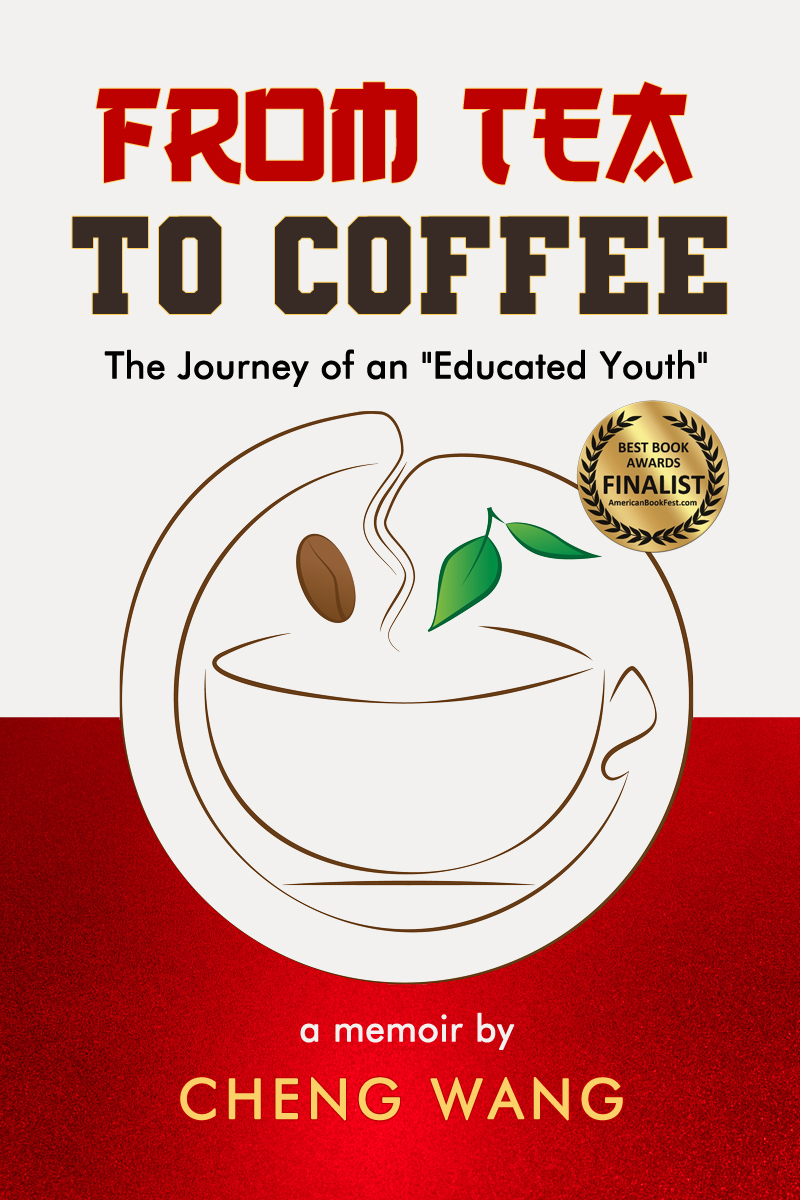
Cheng Wang's memoir, From Tea to Coffee: The Journey of
an “Educated Youth,” chronicles a remarkable journey across half a century
and two continents. Beginning in Mao-era China, Wang is sent as an “Educated
Youth” to a remote Inner Mongolian village for re-education during the Cultural
Revolution. Following Mao's death and the reopening of universities, he passes
the rigorous GaoKao exam, attends college in Dalian, and works in Beijing's
electronics industry. In 1984, seeking broader horizons, he emigrates to the
United States with only $200. Starting as a graduate student in Cincinnati, he experiences
culture shock, learns English, and builds a successful career in technology in
North Carolina. He works odd jobs like food delivery. He overcomes significant
language barriers. He marries his college sweetheart, Peiyuan, and raises a
family in America. His journey mirrors the socioeconomic shifts of modern
China.
Stylistically, Wang writes with candid humility, blending
historical exposition with intimate personal anecdotes. The prose is
straightforward yet evocative, capturing the zeitgeist of 1960s China and 1980s
America. The title metaphorically represents his cultural assimilation,
shifting from traditional Chinese tea to American coffee. Key personalities,
such as the supportive Party Secretary Cong and the resourceful Uncle Zhao, reinforce
the complexity of human relationships in a time of political turmoil. Major
themes include grit, the impact of generational trauma, and the reconciliation
of Eastern collectivism with Western individualism. Wang avoids bitter
resentment, instead offering a nuanced perspective on how extreme ideologies
shape societies. His reflection on identity, feeling at home on both sides of
the Pacific, is a powerful aspect of the memoir. This honest examination
provides Western readers with insight into the formation of modern China while
universalizing the immigrant struggle for belonging. Wang's voice remains
authentic throughout, and From Tea to Coffee inspires, especially those
undergoing the immigrant experience.







 Mommys_Boy_6x9.jpg)





.jpg)

































.jpg)




.jpg)